
Considerações práticas#
Recomendamos conferir Microtutor e MyScope para explicações interativas de muitos desses conceitos!
Escolha da objetiva#
As objetivas do microscópio têm vários recursos que devem ser considerados ao decidir qual objetiva é a certa para o seu experimento
Magnification and resolution: the higher the numerical aperture (NA) of the lens, the finer the resolution one can obtain in one’s sample. The NA is calculated as \(NA=RI * sin(θ)\), relating both to the refractive index of the sample, glass, and immersion media as well as the range of angles of emitted light that can be collected into the lens. Unless special techniques are used, the typical limit of resolution is calculated as \(d = λ / 2NA\), meaning the resolution is set both by the NA of the lens but also by the wavelength of light used for imaging.
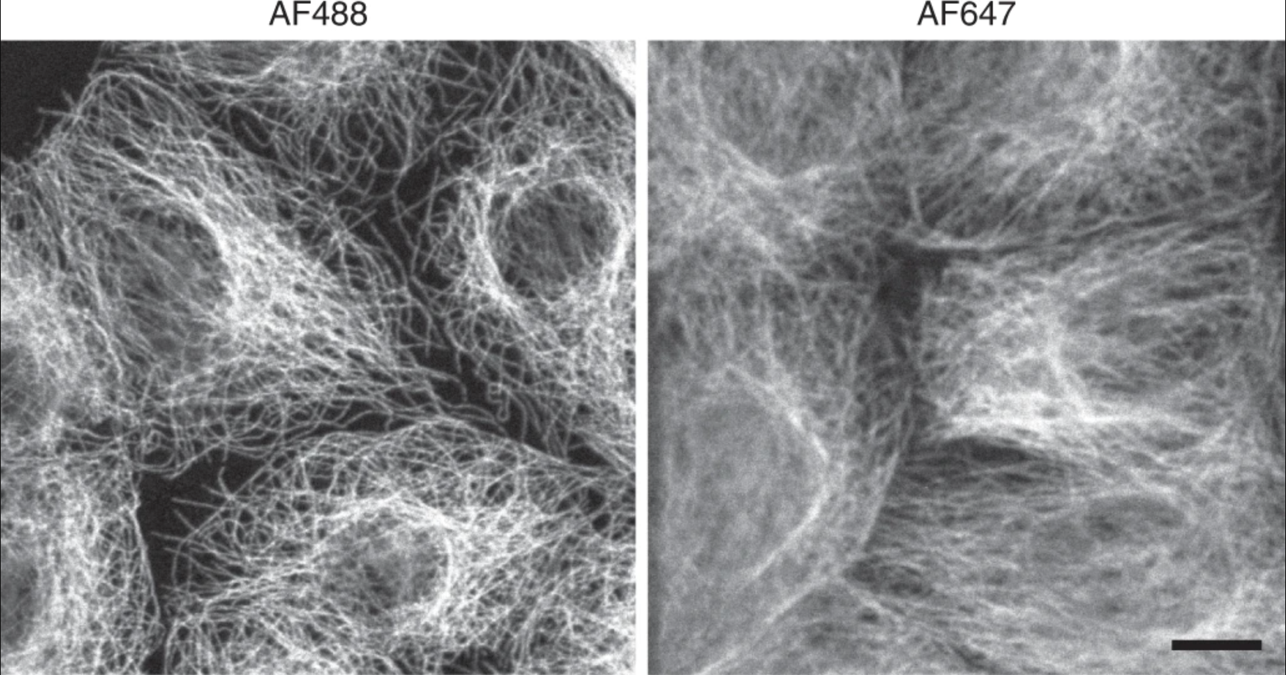
Fig. 5 Resolução reduzida em comprimentos de onda de luz mais longos. Os microtúbulos fotografados em um comprimento de onda de luz mais curto mostram uma resolução maior do que aqueles fotografados em comprimentos de onda mais longos. Adaptado de Jonkman J., Brown C.M., Wright G.D et al. Tutorial: orientação para microscopia confocal quantitativa. Nat Prot 15, (2020) 5#
Correção de cores: Ao realizar a microscopia multicolorida, é importante escolher uma lente objetiva rotulada como “Apo” ou “Super Apo”, pois essas lentes são corrigidas para focar de 3 a 6 cores no mesmo plano ao mesmo tempo. As lentes
Fluornormalmente focam duas cores ao mesmo tempo.Distância de trabalho: A distância de trabalho (WD) dá a distância em milímetros que a lente pode focalizar na amostra. Essa distância inclui a lamínula e o meio de montagem. Ao obter imagens de uma amostra espessa e/ou se precisar obter imagens longe da superfície da amostra, é importante garantir que a lente tenha uma distância de trabalho suficiente.
Conjuntos de filtros#
It is important to make sure that the microscope that you want to image on has the correct filter sets for the fluorophores you wish to use. See the section on bleedthrough for more information.
amostragem em Z#
If you wish to capture multiple z sections, the spacing of these sections is important if you wish to be able to perform an accurate 3D reconstruction. SVI has a fuller mathematical explanation of this,as well as an easy-to-use online calculator that you can use to calculate the optimal z section spacing for your imaging conditions.
Potência/velocidade de aquisição#
The amount of signal captured from any fluorophore will be related not just to the intrinsic brightness of the fluorophore, but also the amount of excitation light it is exposed to (due to duration, power, or both) as well as amount of time and signal multiplication that happens at the detector (typically a camera or a photomultiplier tube (PMT)). An optimal experiment is typically one that minimizes the amount of light hitting the sample (to reduce photobleaching and/or phototoxicity) while achieving adequate fluorescent signal and in minimal time on the equipment. How exactly to balance these competing factors will depend on the exact biology being studied and the researcher’s constraints.